 AirwayControl
Extraordinary circumstances
Weather, strikes, sick crew: when the airline does not have to pay
EU 261 says no compensation is owed when the airline proves the disruption was caused by extraordinary circumstances that could not have been avoided even if all reasonable measures had been taken. Here is what the courts have said about the causes airlines give most often.
General information, not legal advice. Not a promise of payment.
The airline has to show it
The airline does not have to pay compensation if it can prove that the cancellation or delay was caused by extraordinary circumstances which could not have been avoided even if all reasonable measures had been taken (Article 5(3)). The burden is on the airline, not on you. It has to show both: that the event was extraordinary, and that it did everything reasonable to avoid the disruption it caused.
Meals, drinks and a hotel while you wait are owed either way. The Court of Justice ruled in McDonagh that extraordinary circumstances do not release the airline from its duty of care.
What the courts have said, cause by cause
Each row is what a court said about a kind of event. Whether it applies to a given flight depends on the facts, and the airline decides first.
| Cause | Extraordinary? | What was said | Source |
|---|---|---|---|
| Technical fault | No, as a rule | A technical problem is not extraordinary, even when it occurred unexpectedly and was not found in routine maintenance. It can be, where it stems from an event outside the airline's normal activity, such as a hidden manufacturing defect revealed by the manufacturer or an authority. | Wallentin-Hermann, C-549/07, 22 December 2008; van der Lans, C-257/14, 17 September 2015 |
| Crew member ill | No | The unexpected absence, through illness or death, of a crew member essential to the flight, shortly before departure, is not extraordinary. The UK Supreme Court reached the same result under UK law for a pilot who fell ill off duty. | TAP, C-156/22, 11 May 2023; Lipton v BA Cityflyer, [2024] UKSC 24, 10 July 2024 |
| Strike by the airline's own staff | No | A lawful strike by the airline's own staff, called by their trade union to press their demands, is not extraordinary. Nor is a wildcat strike, where staff called in sick after the airline announced a restructuring. | Airhelp v SAS, C-28/20, 23 March 2021; Krüsemann, C-195/17, 17 April 2018 |
| Strike by air traffic controllers or airport staff | It may be | Strikes external to the airline's activity, such as by air traffic controllers or airport staff, may be extraordinary. | Airhelp v SAS, C-28/20, paragraph 42; recital 14 |
| Weather | It may be | The regulation names meteorological conditions incompatible with the operation of the flight as a case where extraordinary circumstances may occur. | Regulation (EC) No 261/2004, recital 14 |
| Air traffic control restrictions | It may be | The regulation says extraordinary circumstances should be deemed to exist where an air traffic management decision about an aircraft on a particular day causes a long delay or a cancellation, even though the airline took all reasonable measures. | Regulation (EC) No 261/2004, recital 15 |
| Bird strike | Yes | A collision with a bird is extraordinary. Extra safety checks by an expert of the airline's own choosing, after an authorised expert had already checked the aircraft, are not. | Pešková, C-315/15, 4 May 2017 |
| Debris on the runway | Yes | Damage to a tyre from a foreign object on the runway is extraordinary. The airline must still show it used all the staff, equipment and money at its disposal to keep the tyre change from causing a long delay. | Germanwings, C-501/17, 4 April 2019 |
| Runway or airspace closed | Yes | Fuel on a runway that closed it is extraordinary, when the fuel did not come from the airline's own aircraft. The closure of part of European airspace after the Eyjafjallajökull eruption was extraordinary, and care was still owed. | Moens, C-159/18, 26 June 2019; McDonagh, C-12/11, 31 January 2013 |
| Unruly passenger | Yes, as a rule | A diversion to remove an unruly passenger is extraordinary, unless the airline contributed to the behaviour or ignored warning signs of it. | LE v TAP, C-74/19, 11 June 2020 |
| A problem on the aircraft's earlier flight | Only with a direct link | The airline may rely on an extraordinary circumstance that affected an earlier flight it operated with the same aircraft, provided there is a direct causal link between that event and the later delay or cancellation. | LE v TAP, C-74/19, 11 June 2020 |
The cases are rulings of the Court of Justice of the European Union on Regulation (EC) No 261/2004, except Lipton, which is the UK Supreme Court. Recitals are the reasons printed at the start of the regulation.
A list in the new rules
Regulation (EU) 2026/2202 amends EU 261 and adds an annex listing events that count as extraordinary circumstances. It applies from 23 October 2027, and the airline will still have to prove a direct link and that it took all reasonable measures. Until then, the cases above are the guide. What changes in 2027.
If the airline names a cause
- Ask what it was. Ask the airline to name the circumstance and the measures it took. The claim template asks for both.
- Compare it with the table. A cause the courts have called ordinary, such as a technical fault or a sick crew member, is a reason to ask again.
- Still no? Take it to the complaints body in the country you departed from.
AirwayControl
Or let the app fill it in.
AirwayControl is a flight tracker for iPhone and Apple Watch. Set your flight before you leave, and it follows the day for you. If the day goes wrong, it already knows the details the claim needs.
- It tells you when it matters. A notification when your flight lands three hours late or more.
- It knows which rules cover your route. EU 261, UK 261 and the rules of 18 more countries, in plain words.
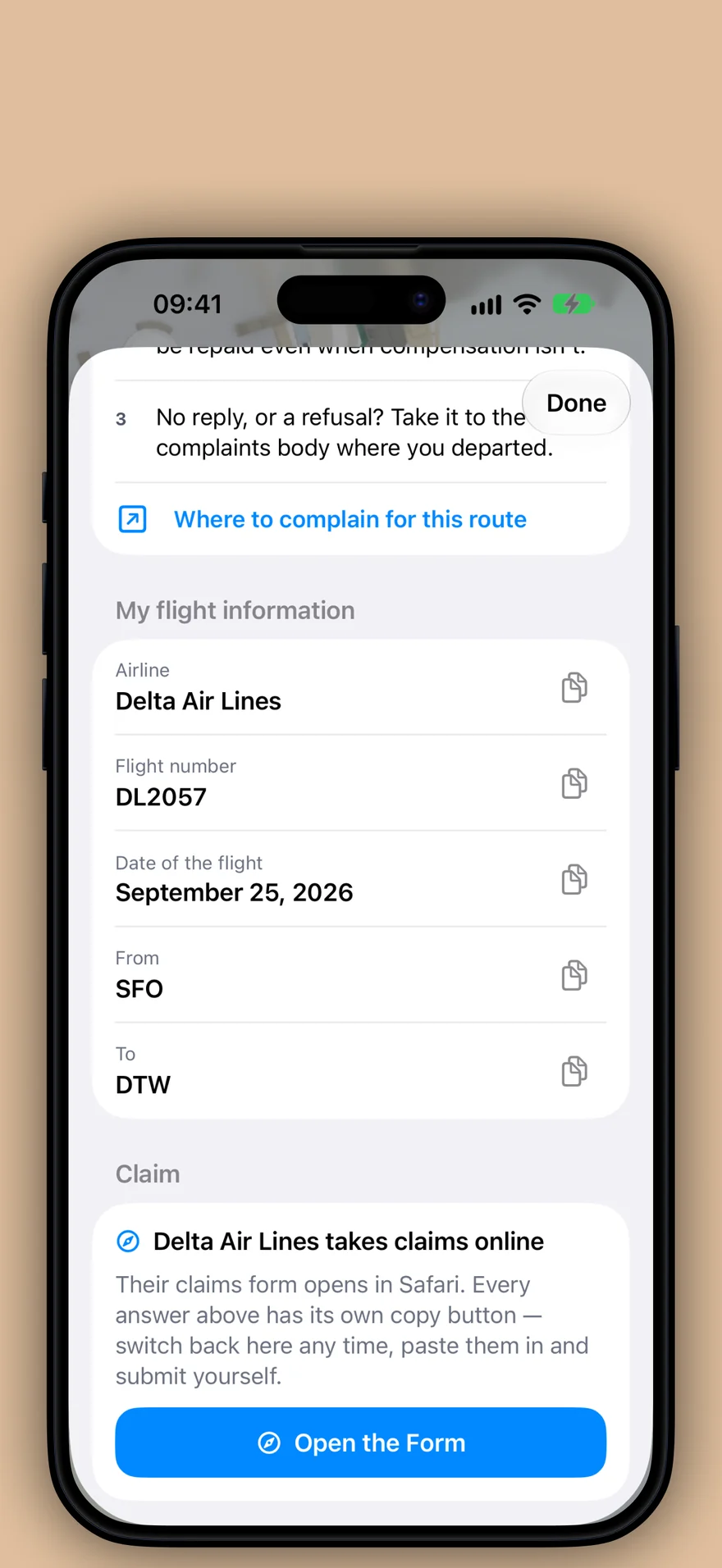
- It fills in the claim. Airline, flight number, date and route come from My Flight.
- You send it. From your own email, or through the airline's own claim form with every answer ready to copy.
- No fee and no share. AirwayControl never takes a part of what you receive.
7 days free, then 29 NOK a month.
Questions people ask
What are extraordinary circumstances on a flight?
Events outside the airline's normal activity and beyond its control, which could not have been avoided even if all reasonable measures had been taken. When the airline proves one caused the disruption, EU 261 says no compensation is owed, but care still is.
Is crew sickness an extraordinary circumstance?
No. The Court of Justice ruled in 2023 that the unexpected absence through illness of a crew member shortly before departure is not extraordinary, and the UK Supreme Court reached the same result in Lipton in 2024.
Is a technical fault an extraordinary circumstance?
As a rule, no. The Court of Justice has ruled that technical problems are part of an airline's normal activity, even when they occur unexpectedly, unless they stem from an outside event such as a hidden manufacturing defect.
Can I get compensation for a strike?
It depends whose strike it was. A strike by the airline's own staff is not extraordinary, the Court of Justice has ruled. A strike by air traffic controllers or airport staff may be.
Does bad weather mean no compensation?
It can. EU 261 names weather incompatible with the operation of the flight as a case where extraordinary circumstances may occur, and the airline has to prove it. Meals and a hotel are owed anyway.
Is AirwayControl a claims company?
No. It tells you which rules cover your route and writes the claim, and you send it from your own email. AirwayControl never sends or handles a claim for you, and takes no share.
Other problems
What the rules say when something else went wrong. The main guide covers delays and cancellations, and the checker shows which rules cover your route.
One subscription. The whole app.
29 NOK a month
The first 7 days are free. No tiers, nothing locked, cancel any time in Settings. No account, no ads, no tracking.
General information about air passenger rules, not legal advice and not a promise of payment. Your airline decides; a complaints body decides on appeal. AirwayControl never submits or handles claims: the mail is yours, from your own account. Rules last checked 9 August 2026. The regulation and the judgments named on this page were read in full on 3 October 2026.
Sources: Regulation (EC) No 261/2004 and the European Union's own guide to air passenger rights. Court of Justice of the European Union, Wallentin-Hermann (C-549/07): the judgment. van der Lans (C-257/14): the judgment. TAP (C-156/22): the judgment. Airhelp v SAS (C-28/20): the judgment. Krüsemann (C-195/17): the judgment. Pešková (C-315/15): the judgment. Germanwings (C-501/17): the judgment. Moens (C-159/18): the judgment. McDonagh (C-12/11): the judgment. LE v TAP (C-74/19): the judgment. UK Supreme Court, Lipton v BA Cityflyer [2024] UKSC 24, 10 July 2024: the judgment.